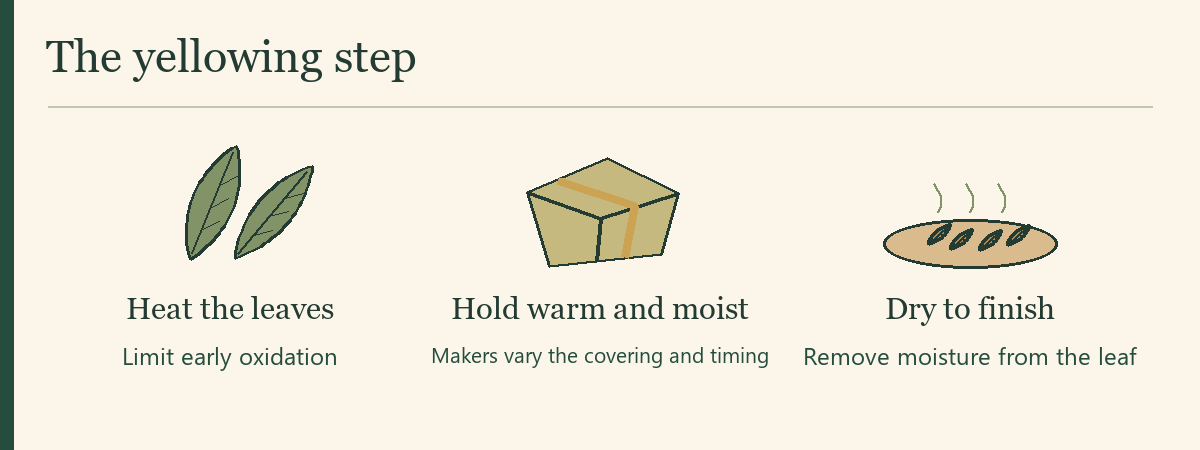
Yellow tea, or huang cha, takes its name from a distinctive part of its making. After the leaves are heated to limit enzyme activity, the maker keeps them warm and moist for a period known as men huang, or yellowing. Moisture and warmth change the aroma, taste and colour of the leaf before drying finishes the tea. Some green and white teas also pour a golden cup, so the colour in the glass alone tells you little about which tea you have.
What yellowing does
Think of the difference between two warm handfuls of leaf. Spread one out and it begins to cool and lose moisture. Gather the other into a covered pile and the centre stays warmer and damper. Yellow-tea makers use this second condition deliberately, adjusting the treatment to the material they are working with. The order of shaping, covering and drying, and the time spent in each stage, depend on the local method. There is no single number of hours that identifies a yellow tea.
Yellowing can soften the grassy edge familiar from some green teas. In the cup you might find a gentle grain-like aroma, a little sweetness or a mellow finish. A maker working with small buds starts with different material from one working with larger leaves. Both picking and finishing influence what you taste. A deeply golden liquor is no guarantee of a fuller flavour.
Bud, small-leaf and large-leaf yellow teas
Chinese yellow teas are often grouped by the material picked. Bud teas use tender shoots. Small-leaf yellow teas include young leaves, while large-leaf yellow teas can include mature leaves and long stems. This distinction matters if your first yellow tea tasted like toasted rice and the next one seems almost as light as water.
- Junshan Yinzhen, Hunan. The name of this island-grown bud tea translates as Junshan Silver Needle. Check the whole name on the packet. Baihao Yinzhen, also called Silver Needle, is a Chinese white tea with a different method of manufacture.
- Mengding Huangya, Sichuan. The name means yellow buds from Mount Meng, near Ya'an. The same mountain produces green teas, including Mengding Ganlu. If you want to taste yellowing, look for the full tea name and the maker's account of how the buds were finished.
- Huoshan, Anhui. Huangya is the yellow-bud style. Huang Da Cha, or large yellow tea, shows another side of the region. Mature leaves and stems can take a substantial roast, bringing out an aroma reminiscent of browned rice. A few long stalks among those leaves are part of the picking style.
Why some yellow teas are hard to find
The maker has another decision to make after heating the leaf. How much warmth and moisture should the covered leaves retain, and when should they be opened or dried again? Some regional methods repeat this work in small batches. For teas picked bud by bud, there is also a short window to gather the right material. Large-leaf yellow teas have a different harvest and can be a more accessible introduction to the family.
When choosing a sample, look for a growing region, a description of the picking and a mention of the yellowing step. Together these tell you more about the tea than a photograph of golden liquor. If you like roasted oolong, the toasted character of a large-leaf yellow can be a familiar place to begin. If you usually brew spring green teas, try a small packet of yellow buds and compare the two side by side.
Three profiles to explore
- Junshan Island Yellow Tea offers a bud tea associated with Junshan in Hunan. Look at the shape of the dry buds before adding water, then watch how they open.
- Huo Mountain Yellow Tea Buds gives you a second bud-focused example, this time from Anhui. Compare the texture of the liquor and the aroma that lingers after a sip.
- Huo Mountain Yellow Tea provides a useful companion to the buds profile. Read the two accounts together and compare the descriptions of the tea itself. A place name alone leaves plenty of room for different styles.
Brew a small comparison
For a gentle first cup of a tender bud or small-leaf yellow tea, try 2 g in a roomy infuser with 150 ml of water at about 85°C. Taste after 90 seconds and remove the leaves when the strength suits you. This is an experiment for a delicate tea. Follow the maker's recipe when a larger-leaf or more strongly finished example calls for different treatment.
Pour into a light-coloured cup. Smell the warm leaves, take a sip, then taste again as the liquor cools. If the first cup is thin, try a little longer for the next steep. To explore what sets the family apart, brew a familiar green tea alongside it with the same water. Write down which cup feels brisker and which leaves a softer finish before checking the labels.