A packet labelled 黑茶 reads hei cha, literally “black tea” in Chinese. On an English-language tea shelf it is usually called dark tea. The tea you know in English as black tea, such as Keemun, belongs to another family called hong cha (红茶), or red tea. If you have a dark-looking leaf in front of you, the characters on the packet are a much better starting point than its colour.
Where dark tea gets its character
Hei cha includes regional teas whose manufacture and maturation involve microbial activity. Depending on the style, the leaves may be piled, steamed, pressed or kept in baskets, and their flavour can continue to develop in storage. With a Chinese black tea, oxidation in the freshly picked, worked leaves is central to the maker’s process before drying. These different paths can produce cups of a similar colour with quite different aromas.
Try that distinction with two shallow white cups. Brew an unfamiliar dark tea and a Keemun black tea separately, using the instructions for each. Smell the warm leaves before tasting. One dark tea might suggest dry wood or sweet grain, while the Keemun might remind you of fruit or malt. There is no need to find those particular notes. Record what actually distinguishes the two samples once their liquor has cooled to the same comfortable temperature.
Is pu’erh a kind of hei cha?
Ripe pu’erh from Yunnan is a useful example of dark tea. Its moist piling step helps explain why the term “post-fermented” appears on so many labels. The category is wider than pu’erh: Liu Bao from Guangxi and Fu brick tea are distinct regional products. Raw pu’erh complicates a neat family tree because freshly made sheng has yet to undergo the long storage changes associated with mature examples. Classifications vary. When choosing a sample, ask for the processing style as well as the family name. The sheng and shou comparison shows what that distinction tastes like.
Three names worth recognising
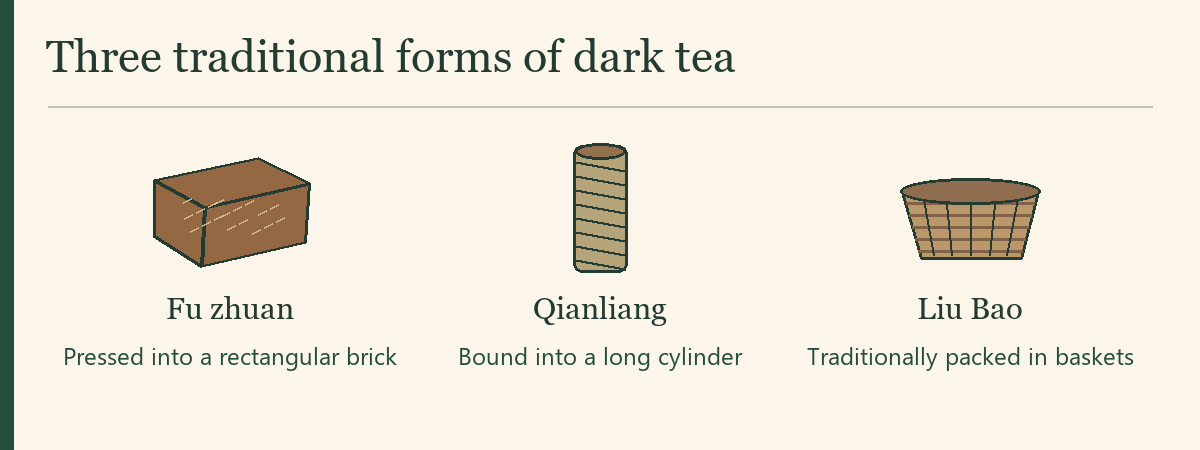
Fu zhuan is a compressed brick tea. In its manufacture, a characteristic fungal growth traditionally called jin hua, or golden flowers, can form within the brick. The name describes a feature of this particular processing tradition. A count of visible yellow specks cannot tell you how a serving will taste. The Golden Flower tea profile gives you a specific example to set beside this broader category.
Qianliang from Anhua in Hunan is traditionally packed into a large, long cylinder, bound around the outside. Most drinkers meet it in the form of a cut slice or a small portion. The same district produces other dark teas, including Tianjian. Seeing different shapes under the Anhua name is quite normal. The district identifies a place, while a name such as Qianliang gives you a clue to the tradition and form.
Liu Bao comes from the Wuzhou area of Guangxi and has a long association with basket packing and storage. Your serving may arrive as loose leaves in a small packet with no basket in sight. Keep the label if you decant it into a tin. The place and the name of the tea will still be useful after you have forgotten what the original packaging looked like.
Start with a cup you can adjust
For a first tasting, choose a small loose portion or a piece already separated from a brick. Try about 3 grams in a roomy basket with 200 millilitres of water at roughly 95°C. Taste after about two minutes, then lift out the basket. Treat these figures as a starting point and use the maker’s directions if they give a recipe for your tea. A dense piece may still be opening while loose leaves have already given a full-flavoured cup.
Keep a little of the first infusion to compare with the second. If the second is stronger, look at how much the leaf has opened before increasing the time. If the cup seems heavy or drying, pour sooner. If the aroma is clear but faint, let the next steep run a little longer. Gongfu brewing offers another way to follow these changes if you have a small pot or gaiwan.
Read beyond colour and age
Look for the tea name, its stated origin and a description of its form. Where a seller gives a year, check whether it refers to picking, production or packing. Storage affects the cup, so it is worth tasting a sample before choosing a large brick. Golden flowers belong to a defined manufacturing process. Unexpected fuzzy patches or a damp, spoiled smell on tea in your cupboard are a reason to discard it. For your next comparison, choose another named dark tea from a different region and brew it in the same cup. You will have two actual teas to remember instead of one broad colour on a label.
Why are so many dark teas packed into bricks and baskets?
A bundle has a practical advantage when moving a large quantity of bulky leaf. Bricks stack, a bound cylinder holds its shape and a basket can contain loose tea. Compressed teas travelled inland on trade routes, including the trade in Sichuan teas for Tibetan markets. Tea associated with those routes can still appear as Tibetan tea or zang cha. The market name and the place of manufacture can refer to different places. Check where the maker actually produced it.
Regional shape names also preserve distinctions that disappear in an English translation. A Hubei green brick, qing zhuan, belongs to the dark-tea tradition despite “green” in its name. Liu Bao (六堡) from Guangxi and Lu’an basket tea (六安篮茶) from Anhui have similar-looking names in roman letters. Keep the Chinese name alongside the region in your tasting notes. It is much easier to find the right tea again than by searching for “old basket tea”.
Choosing and keeping a first sample
Start with two small portions sold under different names. A loose Liu Bao and a portion of Fu brick let you compare forms as well as flavours. Get enough of each for two sessions; that gives you a second chance to adjust the brewing if the first cup is too thin or too concentrated. A production year without any storage history is little help in explaining a high price. Ask about the actual batch and its storage, then taste it before buying a large brick.
Protect the drinking portion from damp and odours. Keep a dry scoop with it and leave the rest undisturbed. There is no need to encourage visible growth at home. If your packet identifies golden-flower Fu tea but a particular patch looks unfamiliar, do not try to decide its safety by comparing colours on a screen or taking a sip. Keep the label and contact the supplier.