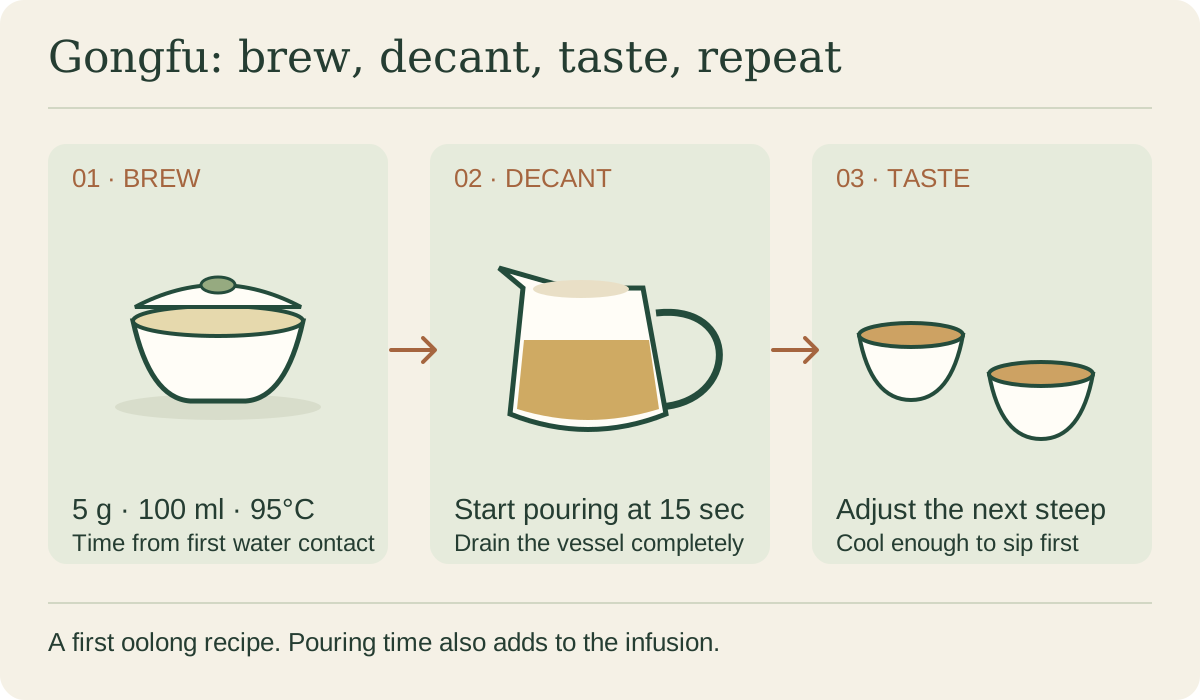
Gongfu tea brewing uses a small vessel, a relatively generous amount of leaf and a series of short infusions. You pour each infusion away from the leaves before making the next. This gives you a chance to notice how one tea changes across a session, instead of combining its flavours in a single long brew.
You can begin with a small teapot or a gaiwan, the Chinese lidded bowl used for brewing and serving tea. An elaborate tray, a collection of clay pots and a rehearsed ceremony are not prerequisites. The practical skill is learning to control the water, timing and pour so that the tea tastes the way you enjoy it.
The equipment you actually need
Choose a small brewing vessel that is comfortable to handle. Around 100 millilitres is a manageable starting size for one person or two people sharing small cups. A glazed porcelain gaiwan is versatile, while a small teapot with a handle may feel easier when you first work with hot water.
Add a kettle, a cup or two, and somewhere to discard water. A small serving pitcher is helpful when sharing: decanting the entire infusion into it mixes the tea before you divide it between cups. A scale and timer make your first experiments easier to repeat. A strainer is optional if leaf fragments bother you.
Check the vessel's working capacity rather than filling to the rim. Leave room to handle it securely. Before using hot water in an unfamiliar gaiwan, practise with cool water over a sink. Tilt the lid to leave a small pouring gap and find a comfortable grip. If the rim or lid becomes too hot to hold safely, set it down and use a handled pot instead.
A first recipe with oolong
For a straightforward first session, choose a loose-leaf oolong and begin with 5 grams of tea for roughly 100 millilitres of water. Use water around 95°C and an initial infusion of about 15 seconds. These figures are a starting point for this exercise, not a definition of authentic gongfu or a promise that every oolong will taste best this way.
- Warm the vessel. Add hot water, then carefully discard it. Warm the pitcher and cups if you are using them.
- Add the measured leaf. Notice its shape and aroma. Compact rolled oolong can expand considerably, so do not assume the vessel needs to look full when dry.
- Fill and begin timing. Pour smoothly over the leaves. Keep your timing convention consistent: for this recipe, start when water first meets the tea.
- Decant promptly. At about 15 seconds, begin pouring the infusion into your pitcher or cup. Empty the vessel thoroughly without shaking it. A slow pour extends the leaves' contact with water.
- Taste before refilling. Let the drink cool enough to sip, then decide whether the next infusion needs the same time, less time or more.
A quick rinse is sometimes used to moisten tightly rolled or compressed leaves, but it is not compulsory for every tea. If you use one, discard it promptly and remember that the leaves have already started opening. A rinse is not a way to make spoiled or contaminated tea suitable to drink.
Let the next cup guide the timing
Do not automatically make every infusion longer. Rolled leaves may open slowly at first, then give a much stronger second or third cup once water reaches more of their surface. If the first infusion is light, repeat a similar short steep before deciding that the tea needs substantially more time.
When the flavour begins to fade, increase the next steep by a small amount, such as five or ten seconds. Later you may need a more generous increase. Stop when the tea no longer tastes interesting to you. Counting infusions is less helpful than noticing whether the next one is worth drinking.
Keep the leaves drained between rounds. If you leave them sitting in a pool of tea, the next cup becomes harder to control. There is no need to rush from one infusion to another; take time to drink what you have made before adding water again.
Adjusting strength without guessing
If a cup is too strong or drying, shorten the next infusion first. If even a very quick pour is excessive, use less leaf in your next session. For a thin cup, extend the steep modestly; if the whole session remains weak, consider a slightly larger leaf portion next time.
Water temperature is another variable, but change it separately so you can understand the result. Delicate green tea generally calls for gentler heat than this oolong recipe. Roasted oolong and ripe pu'erh often suit hotter water. Follow advice for the particular tea before transferring a favourite recipe unchanged across different families.
A short note is enough: tea name, grams, vessel size, temperature and what you changed. “Second cup too strong; shorten next time” is useful. You do not need a score, an elaborate tasting wheel or a list of flavours you cannot actually detect.
What to notice through the session
Compare the aroma before and after the sip. Notice whether the tea feels light, rounded or drying, and whether the finish disappears quickly or lingers. The strongest infusion is not necessarily the most enjoyable one. Look for the balance that makes you want another cup.
For your first few sessions, repeat one tea in the same vessel. Familiarity makes the effects of a shorter steep or a smaller portion much easier to recognise. Once you can produce a cup you like consistently, try a different oolong and see which parts of your routine carry across. That gradual adjustment is the useful skill at the centre of gongfu brewing.