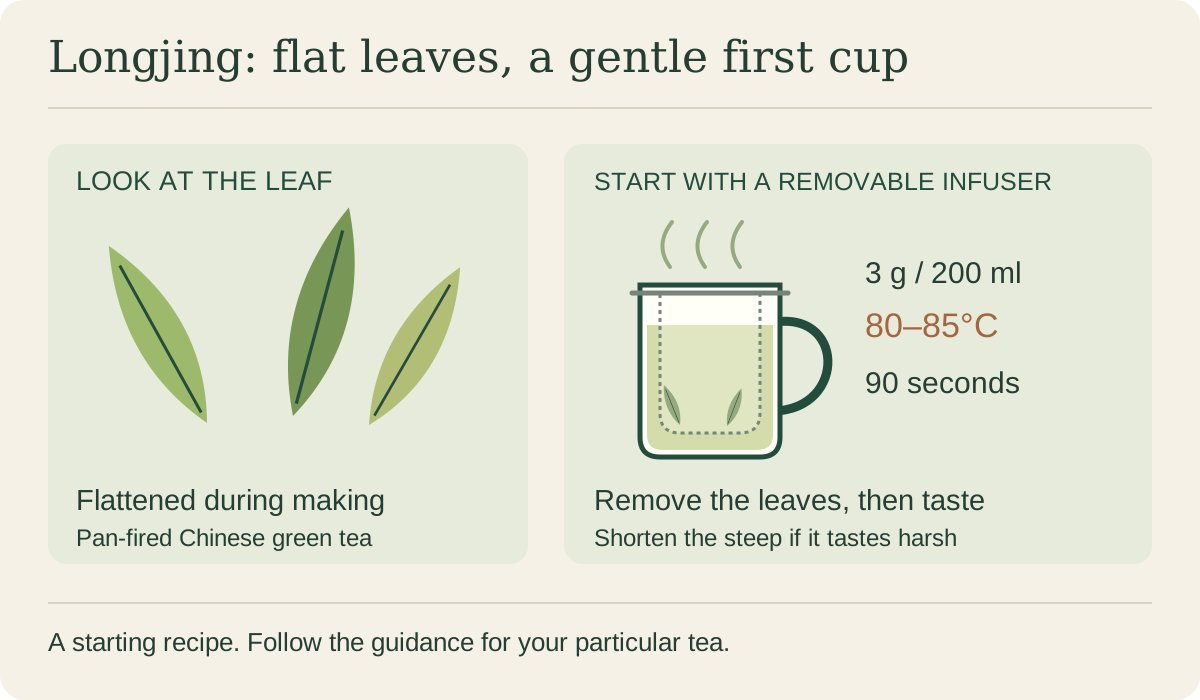
Longjing tea, often called Dragon Well, is a Chinese green tea known for its flat leaves and a flavour that can bring together fresh vegetables, toasted nuts and a gentle sweetness. It is a good tea for learning to notice small differences: how the dry leaf smells, how warm water changes that fragrance, and what happens when you shorten a steep.
You do not need an elaborate tea set to enjoy it. A roomy infuser and a cup are enough. The useful starting points are a measured portion of leaves, water below boiling, and the ability to separate the finished tea from the leaves.
What makes Longjing different?
Longjing is associated with Hangzhou in Zhejiang province, particularly the area around West Lake. The English name Dragon Well translates the Chinese name. During manufacture, heat stops the leaves' enzymatic oxidation, while pan-firing and shaping give the finished tea its characteristic flattened appearance.
The shape is therefore part of the making of the tea, rather than the natural shape of a leaf on the bush. Spread a few dry leaves on a pale plate and look at the bud-and-leaf pieces. Handle them gently: pressing and stirring dry tea to inspect it can create the broken fragments that make brewing less predictable.
A cup may taste nutty, sweet, vegetal or lightly floral. These are descriptions to explore, not flavours every Longjing must deliver in the same proportions. Harvest, processing, storage and your brewing choices all affect the result. A chestnut-like note does not mean nuts have been added.
Longjing and West Lake Longjing
Longjing and Xihu Longjing are not interchangeable labels. Xihu means West Lake and makes a more specific origin claim. Tea offered under the broader Longjing name may come from other producing areas. A familiar name or a photograph of flat leaves is not proof of a particular garden.
When comparing teas, look for a clear origin, harvest year and picking period. Keep those details together rather than choosing on the strength of a grade word such as premium. If the origin matters to you, ask for more precise information than simply China.
You may also see Mingqian, meaning picked before the Qingming festival in early April. It describes harvest timing. Early tea can be expensive, but the label alone does not tell you how carefully a tea was made or stored, or whether its flavour will suit you. A later spring harvest can still be a satisfying everyday tea.
A straightforward cup of Longjing
Try this gentle starting recipe, then adjust for the particular leaves you have. It is intended for a cup with a removable infuser or a small pot that you can empty completely.
- Measure 3 grams of leaves for about 200 millilitres of water.
- Heat fresh drinking water, then use it at roughly 80–85°C. A temperature-controlled kettle or thermometer makes this easier to repeat.
- Put the leaves in a spacious infuser. Pour in the water and leave the leaves room to unfold.
- Steep for about 90 seconds, then remove the infuser or pour all the tea into a cup.
- Let the liquor cool enough to drink comfortably before judging its flavour.
If the cup seems too light, add 20–30 seconds next time. If it tastes harsh or leaves your mouth unpleasantly dry, shorten the steep first. Change one thing at a time. Altering the temperature, leaf quantity and time together makes it difficult to learn which adjustment helped.
Reinfuse the same leaves during your session. Start with a similar steeping time and extend it if the flavour has weakened. There is no need to achieve a fixed number of cups; stop when another infusion no longer tastes enjoyable.
Brewing directly in a glass
Longjing also suits the informal method often called grandpa-style brewing: leaves remain in the drinking glass, and you add more water as you drink. Use less leaf than you would for a short, fully drained infusion, since the contact with water continues.
For a first attempt, put about 2 grams in a heat-resistant glass of roughly 250 millilitres and add water around 80°C. Allow the leaves to soften and the drink to cool. Sip carefully, keeping floating leaves away from the rim. Top up while some tea remains in the glass, and adjust the amount of water to the strength you prefer.
When the flavour seems wrong
A weak cup does not always need hotter water. First check that you used enough leaf and gave it enough time. If the aroma is pleasant but the flavour disappears quickly, try a slightly larger portion in your next session. If the cup is strong but drying, use a shorter steep.
Store the dry tea tightly closed, away from light, dampness, heat and strong kitchen smells. Mark the opening date on the packet and buy quantities you will enjoy while the tea still tastes fresh. A famous origin is worth little if the leaves sit open beside the cooker.
A useful first tasting
Make two small cups from the same packet, with equal leaf and water quantities, but steep one a little longer. Taste both as they cool. Write down which feels sweeter, fuller or more drying, using words that make sense to you. That small comparison will teach you more about your Longjing than trying to reproduce somebody else's tasting description exactly.