Da Hong Pao is an oolong tea associated with the Wuyi Mountains of Fujian, China. Its name is commonly translated as Big Red Robe. It belongs to the family called yancha, or rock tea, and often offers a combination of roasted warmth, fruit or floral fragrance, and a lingering finish.
The dark leaves can make it look like a black tea, but colour alone is a poor guide to classification. Da Hong Pao is an oolong: its manufacture includes controlled oxidation, followed by heating and roasting. To understand the cup, pay attention to both the underlying tea and the way it has been roasted.
What does Da Hong Pao taste like?
There is no single flavour shared by every packet. Some examples emphasise toasted or baked notes; others leave more room for flowers, fruit or spice. The balance depends on the leaf material, blend, processing and roast.
When tasting, separate aroma from texture. Smell the warm leaves, take a small sip, then notice how the tea feels in your mouth and what remains after swallowing. A strong roast aroma and a thick-feeling liquor are different qualities. One does not guarantee the other.
The name on a modern packet
The famous old Da Hong Pao bushes are part of the tea's history, but an ordinary packet should not be assumed to contain leaves from those bushes. Modern Da Hong Pao is commonly sold as a blend of Wuyi oolongs. A blend can be deliberately composed to balance fragrance, body and aftertaste.
That makes the maker's description important. Look for a stated growing area, harvest information and an explanation of the roast or blend when available. Do not assume that two teas bearing the same name will taste alike, or that a blend is automatically inferior to a tea made from one cultivar.
The useful question is what is actually in this packet. Stories about rare historical tea and spectacular auction prices do not answer that question. For everyday drinking, clear information and a cup you enjoy are more helpful than a dramatic legend.
Brewing in a gaiwan
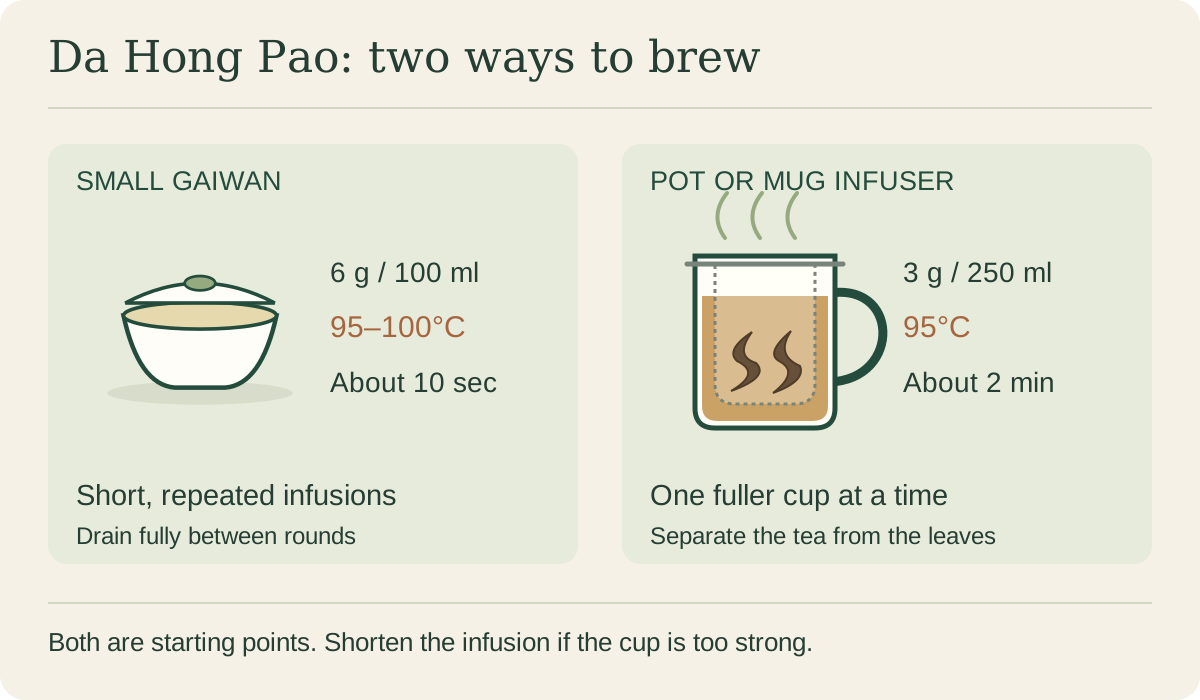
Short, repeated infusions are a rewarding way to explore Da Hong Pao because the balance of roast and fragrance can change through the session. A porcelain gaiwan makes it easy to see the leaves and compare teas without a seasoned clay pot adding another variable.
For a first session, use the following as an adjustable starting point:
- Warm a roughly 100-millilitre gaiwan and your cups, then empty the warming water.
- Add about 6 grams of dry tea. Handle the long leaves carefully rather than crushing them to fit.
- Use water at 95–100°C. If you choose to rinse, pour in a little water and drain it promptly; a rinse is not a way to make questionable tea safe.
- For the first drinking infusion, start with about 10 seconds before pouring. Drain the gaiwan completely into a serving pitcher or cups.
- Keep the next infusion short, taste it, and then lengthen later steeps as the flavour becomes lighter.
These timings are a guide rather than a rule. Filling and pouring take time too, especially with a slow-draining vessel. If your first cup is too concentrated, begin pouring sooner or use less leaf next time. You do not need to copy the heavier leaf quantities used in some traditional sessions to enjoy the tea.
Practise pouring a gaiwan with cool water before using boiling water. Keep your fingers on the rim and lid knob, leave a small opening for the tea to flow, and avoid filling above a level you can handle comfortably.
Brewing in an ordinary teapot
A large pot or mug infuser works well when you want one fuller cup instead of a sequence of small ones. Start with approximately 3 grams of tea for 250 millilitres of water at 95°C, and steep for about two minutes. Pour the tea away from the leaves or lift out the infuser.
If that cup is too light, extend the next attempt by around 30 seconds. If it is strong and drying, shorten the time. A roomy basket gives the leaves more space than a tightly packed tea ball and makes it easier to drain them.
You can brew the same leaves again during the session. Taste rather than counting infusions: a large-pot recipe and a concentrated gaiwan recipe will not produce the same number or strength of cups.
Roast, bitterness and troubleshooting
Roasted flavour is part of many Da Hong Pao teas, but it should not prevent you from noticing anything else. If every cup tastes overwhelmingly strong, reduce extraction before deciding the tea is unsuitable. Try a shorter infusion while keeping the leaf weight and water temperature steady.
If the tea is weak and the fragrance seems absent, check your water temperature and whether the vessel was warmed. If a stronger brew brings only more dryness, more extraction may not be the answer. Different roast styles and blends suit different tastes, and it is reasonable to prefer one over another.
Keeping the tea between sessions
Close the packet firmly and keep it in a dry cupboard away from sunlight, steam and scented foods. Do not leave a tea bag open while cooking or use a damp spoon to measure leaves. If you transfer the tea to a container, retain the original label so you can track its origin and harvest.
Keep a short note of the recipe that worked: leaf weight, vessel size, water temperature and first steep. On your next session, begin there and make one small adjustment. Familiarity with your own packet is more useful than searching for a single perfect recipe for every Da Hong Pao.