Grandpa-style tea is loose-leaf tea brewed directly in the cup you drink from. The leaves stay in the water, and you top up the cup as you go. There is no separate brewing pot to empty and no series of carefully timed infusions. A mug, some tea and a kettle are enough.
The name is an informal English-language label for an everyday way of drinking tea. It is useful when you want a cup beside you rather than a table arranged for a tasting. The important adjustment is to use relatively little leaf: because the leaves remain submerged, a full gongfu portion would usually make an overwhelming mug.
A straightforward first cup
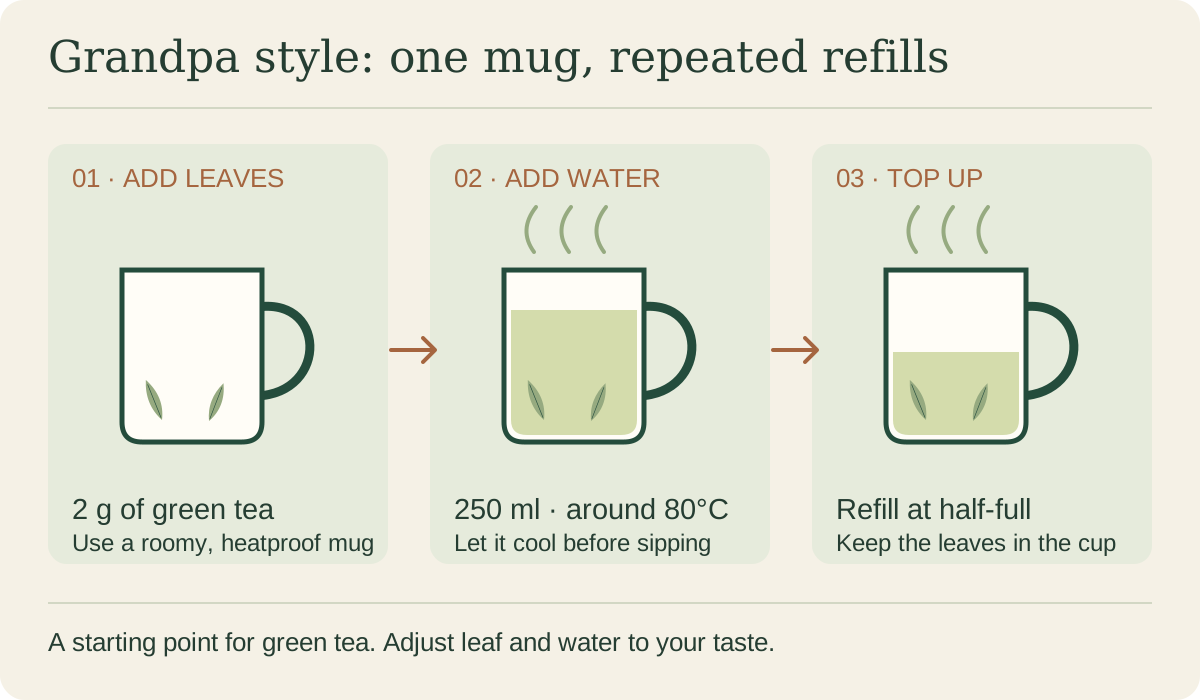
For a first attempt, try 2 grams of Chinese green tea in a heatproof mug that comfortably holds about 300 millilitres. Use water around 80°C, or follow the instructions supplied with your particular tea. This is a deliberately gentle starting recipe, not a rule for every leaf.
- Put the leaves in the clean mug. A scale helps for the first few sessions; a spoonful is unreliable when comparing flat leaves with tightly rolled tea.
- Add about 250 millilitres of hot water, leaving space below the rim. Let the leaves soften and the drink cool to a comfortable sipping temperature.
- Taste a small sip. You can wait longer if it is weak; you do not need to finish a fixed steep before drinking.
- When roughly half the drink remains, add more hot water. The remaining tea gives the refill a little strength while the leaves continue infusing.
- Repeat while you still enjoy the flavour. Stop when the cup becomes thin and the next refill no longer offers much.
There is no useful universal promise of three, five or ten refills. Leaf amount, tea type, mug size and how quickly you drink all change the result. Treat the first mug as a way to find a comfortable balance, then repeat that balance next time.
Which teas work well?
Chinese green tea is an approachable place to start. Longjing's flat leaves are easy to watch in a clear heatproof glass, while other whole-leaf greens give you different aromas and textures to compare. Use the green-tea recipe above as a starting point and adjust for the actual tea rather than its name alone.
Roasted oolong can also suit this method. Begin with a small portion and hotter water than you would normally use for a delicate green. A leaf that tastes agreeable through a long infusion is a better choice than one that becomes sharply bitter very quickly. Ripe pu'erh is another possible choice, though its darker liquor makes strength harder to judge by colour alone.
Whole leaves and larger pieces are easier to drink around than fine fragments. You do not need to reject a tea because a few leaves float, but a dusty broken-leaf blend may be more comfortable in a removable infuser. Choosing a different vessel is a practical adjustment, not a failure to brew correctly.
How to drink around the leaves
Give the leaves time to absorb water. Some settle readily and others remain near the surface; sinking is not a test of quality. Sip slowly from a clear patch near the rim. If your mug has a suitable lid, you can use it carefully to hold back floating leaves, provided you can do so without touching hot surfaces.
Do not fill the cup to the brim. Room at the top makes it easier to carry, sip and dilute the tea. Use a vessel intended for hot drinks, and let the drink cool before tasting. A transparent glass is helpful for observing the leaves, but it should be heatproof rather than an ordinary drinking glass.
Fixing a cup that gets too strong
If the first fill is pleasant but the last few mouthfuls become harsh, refill sooner. If it is already too strong before it cools enough to drink, use less leaf in the next mug. You can dilute the present cup with water; if the mug is full, pour a little tea into another cup first.
For a green tea that remains uncomfortable, try slightly cooler brewing water as a separate experiment. Change one thing at a time. Reducing the leaf, changing the water and switching tea simultaneously may improve the drink, but it will not tell you which adjustment helped.
A cup that stays weak needs a different response. Allow more time before the first sip, or use a little more leaf next time. Check that the mug is not much larger than the recipe assumes. Two grams in a small cup and two grams in a half-litre tumbler are quite different brews.
Grandpa style or gongfu?
Grandpa style gives you an evolving mug: new water mixes with the tea already there. Gongfu brewing separates the infusions, making it easier to compare the opening cups with later ones. Neither approach needs to be your only method.
Try the same tea both ways on different days. Note the leaf amount, cup size and whether you enjoyed the finish. Those three observations are more useful than trying to copy an elaborate routine. For a quiet cup during ordinary daily tasks, the simplest preparation may be the one you reach for most.