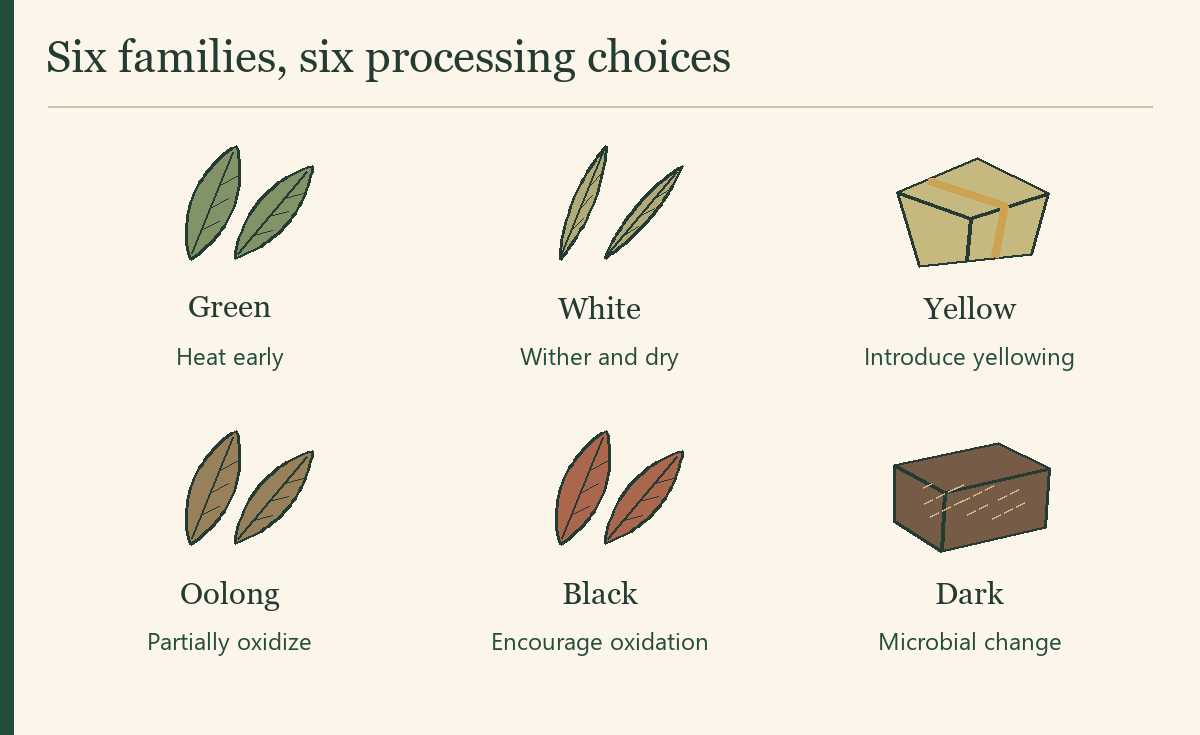
Put a flat green Longjing leaf beside a dark strip of Wuyi oolong and a fuzzy Silver Needle bud. All three come from the tea plant, Camellia sinensis. Chinese tea makers distinguish six families chiefly by what happens to the shoots after picking. The six families are green, white, yellow, oolong, black and dark tea. A maker can heat a leaf while it is still fresh, let it soften and change in the air, or hold it warm and moist. Each decision leaves a trace in the finished cup.
Green tea · lǜ chá
Heating the fresh leaves early slows the enzymes responsible for oxidation. This helps green tea keep some of the fresh aromas of the picked shoot. How a maker applies heat and shapes the leaves gives individual greens much of their personality. Longjing is flattened in a heated pan and can smell like chestnuts or fresh beans. Taiping Houkui has long, broad leaves. Open both packets before brewing and the differences in shape are already striking.
White tea · bái chá
For traditional white tea, the maker spreads the picked shoots out to wither, then dries them. Moisture leaves gradually and the chemistry of the leaf changes during the wither. Weather, airflow and the depth of the spread all affect that work. Silver Needle shows what the downy buds look like on their own. In White Peony, buds sit among open leaves. A cup might suggest meadow hay, flowers or honey, even when the only ingredient is tea.
Yellow tea · huáng chá
Yellow tea shares an early heating step with green tea. Its distinguishing step is a period of yellowing under warm, moist conditions. Makers vary the timing and handling according to the tea. If a green tea tastes brisk to you, try a yellow alongside it and pay attention to the softer impression some examples give. The yellow tea guide introduces examples, including the slender buds of Junshan Yinzhen. A green tea can also pour yellow, so the colour in the cup tells only part of the story.
Oolong tea · wūlóng chá
Oolong makers wither the leaves, handle or bruise them to encourage oxidation, then apply heat to arrest it at a chosen stage. They shape and dry the leaf, and some styles receive further roasting. Think of oxidation and roast as two separate decisions. You might find a striking floral aroma in one oolong and a warm toasted aroma in another. Try Da Hong Pao to explore roast and texture. Let a second infusion cool a little before deciding which flavours linger.
Black tea · hóng chá
Chinese hóng chá literally means red tea and corresponds to the English category black tea. The maker withers and rolls the leaf and allows substantial oxidation before drying. Rolling breaks leaf cells and brings their contents together, helping the colour and aroma develop. Keemun and Jin Junmei are two starting points. If you know black tea mainly from a strong breakfast blend, taste either one plain first. There may be a fragrance you would otherwise miss.
Dark tea · hēi chá
This family includes teas whose character develops through microbial activity during processing. Fu brick tea is one example. Some dark teas are pressed into bricks, baskets or cakes, but the shape is a way of finishing and packing the leaf. White tea can also be pressed. Read a packet for the named tea and process before using its shape as a clue. The Golden Flower tea profile introduces one particular brick tea within this much wider family.
Six regional teas to try at home
Use these as first-cup experiments for loose leaf in a mug. Start each with 2 grams of leaf in 200 millilitres of water and drain the infuser when the cup tastes good. The temperature and time go with the example in that row. A broken leaf or a tightly compressed piece can open quite differently.
| Family and example | Region | Water and time |
|---|---|---|
| Green · Longjing | Zhejiang | 80°C, 90 seconds |
| White · White Peony | Fujian | 85°C, 2 minutes |
| Yellow · Junshan Yinzhen | Hunan | 80°C, 2 minutes |
| Oolong · Da Hong Pao | Wuyi, Fujian | 95°C, 2 minutes |
| Black · Keemun | Anhui | 90°C, 2 minutes |
| Dark · Liu Bao | Guangxi | Just boiled, 3 minutes |
Where do pu'er, jasmine and chrysanthemum fit?
Ripe pu'er from Yunnan goes through moist piling, in which microbes transform the leaf. Raw pu'er skips that accelerated step and develops over time in storage. Calling either one simply “black tea” loses an important distinction. The enzymes in rolled Keemun leaves react with oxygen during manufacture. The microorganisms at work in a pile of ripe pu'er are doing something different.
Jasmine green tea starts with green tea leaves that take up the fragrance of jasmine blossoms. It still belongs to the green family. A pot made entirely from dried chrysanthemum flowers is a flower infusion and falls outside the six. If the front of the packet just says “jasmine,” the ingredient list can settle which drink you have.
Where to begin tasting
Choose a pair with a clear point of difference. Longjing and White Peony make a gentle introduction to early heating versus withering. For a deeper pair, choose a roasted Wuyi oolong and a Chinese black tea. Serve both in pale cups, smell the wet leaf, and try each drink twice as it cools. A simple note like “toasty in the first sip, sweet at the end” will help you remember which tea you want to brew again.
You will also see names that describe another aspect of tea. Jasmine tells you about scenting, Wuyi tells you about a place, and a spring harvest tells you about timing. A packet can carry several of these descriptions at once. Once you know the family, use those other details to narrow down the cup you are looking for.